


Articles
The History of Dunsborough House
Located in Ripley, Surrey, Dunsborough Park is situated adjacent to Ripley Green within its own park and boasts a rich history dating back to the dissolution of the monasteries in the sixteenth century. It was originally part of the estates of Newark Abbey and later became a property of the Kings of Ockham Park.

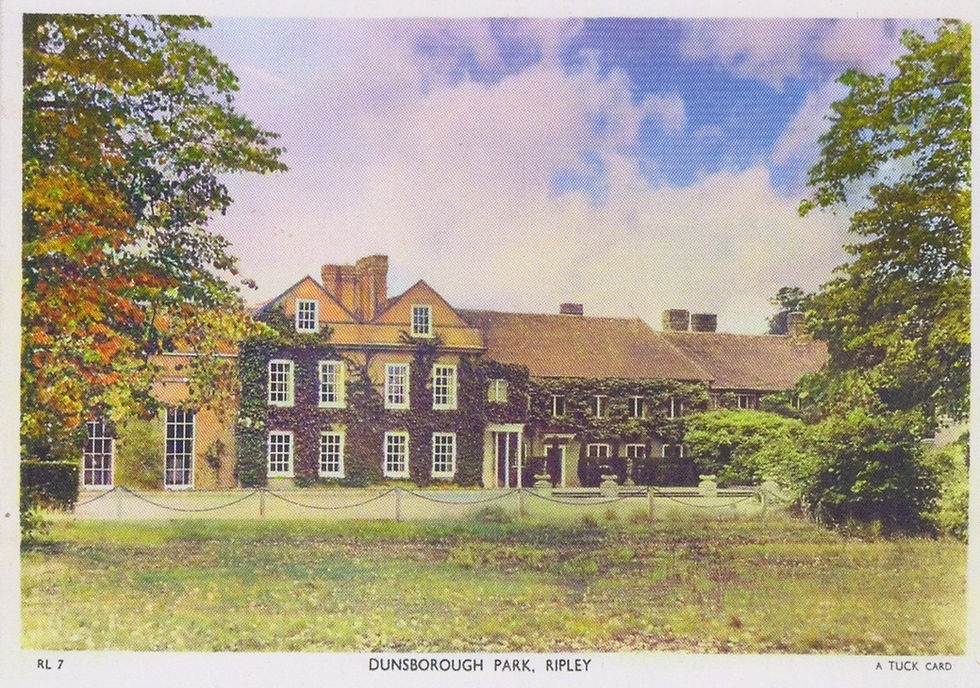
Dunsborough House was constructed in 1630 as a farmhouse, built around a central brick chimney. In the eighteenth century, the gardens were formally laid out when the Lord King’s son acquired the freehold from the Lord of the Manor of Send and Ripley and sold the property and land to Lt Colonel George Onslow, MP for Guildford, in 1785. The house was subsequently enlarged and modernised by successive generations of the Onslow family. An inscription from 1785, featuring the initials of Lt Col Onslow’s sons—the Rev George Walton Onslow, the Rev Arthur Onslow, and Pooley Onslow—remains visible in the brickwork. A notable addition is a single-storey southern annex comprising two elegant rooms, added by George Onslow in 1786.
Following the death of George Onslow’s son, Pitcairn, in 1894, the house was purchased in 1899 by George Maitland-King JP, former Surveyor-General of Hong Kong. It was later sold in 1905 to Charles Cleverly, JP, also a Surveyor-General in Hong Kong. Cleverly built a rifle range in the field south of the house, which no longer exists. After his death in 1921, a memorial was erected in his honour in the parish church.
The estate’s fascinating history continued into the 1930s when the house was sold to Oliver Simmonds MP, a prominent aviation pioneer, aircraft engineer, and Conservative Party politician, known for his design of a twin-engine aeroplane, which was the first prototype for the Spitfire, and his involvement in the first report on supersonic flight. In 1939, W Braxton Sinclair designed the Tudor-style gatehouse at the entrance to Dunsborough Park and shortly thereafter, the octagonal pumphouse, bridge, pavilion, greenhouses, and ha-ha were built.
In 1948, the estate was acquired by Charles Hughesdon, husband of the actress Florence Desmond, and Dunsborough Park became renowned for hosting elaborate entertaining events for film stars and other celebrities, including an annual helicopter party from 1956 to 1973.
Baron and Baroness Sweerts de Landas Wyborgh moved to Dunsborough Park in 1994 and undertook a major restoration project of the house and gardens. The gardens have preserved the original pattern of walls and yew hedges but have also been redesigned by Penelope Hobhouse and Rupert Golby to complement the magnificent collection of outdoor statuary and garden ornaments.
The labyrinth of carefully sculpted and meticulously maintained gardens includes vibrant wisteria enshrining the house, guarded by elegant topiary peacocks, a 300-year-old Mulberry tree, and magnificent tulip displays each spring. Further highlights of the Park include the Victorian walled garden edged with apple trees, the romantic rose walk, and the majestic palm house, divided into separate rooms to provide a range of ‘climates’ to suit the environmental needs of Mediterranean and exotic plants. Today, the 100-acre estate with its historical gardens, immaculate lawns, and greenhouses, provide a picturesque setting for events and visits.
Baron and Baroness Sweerts de Landas Wyborgh moved to Dunsborough Park in 1994 and undertook a major restoration project of the house and gardens. The gardens have preserved the original pattern of walls and yew hedges but have also been redesigned by Penelope Hobhouse and Rupert Golby to complement the magnificent collection of outdoor statuary and garden ornaments.
The labyrinth of carefully sculpted and meticulously maintained gardens includes vibrant wisteria enshrining the house, guarded by elegant topiary peacocks, a 300-year-old Mulberry tree, and magnificent tulip displays each spring. Further highlights of the Park include the Victorian walled garden edged with apple trees, the romantic rose walk, and the majestic palm house, divided into separate rooms to provide a range of ‘climates’ to suit the environmental needs of Mediterranean and exotic plants.
This unique collection of garden statuary and ornaments showcases the finest names in English and Dutch sculpture and decorative arts. Featuring works from Coade and Compton to Van Baurscheit and Van Nost, the collection is magnificently displayed in the splendid setting of Dunsborough Park.


